
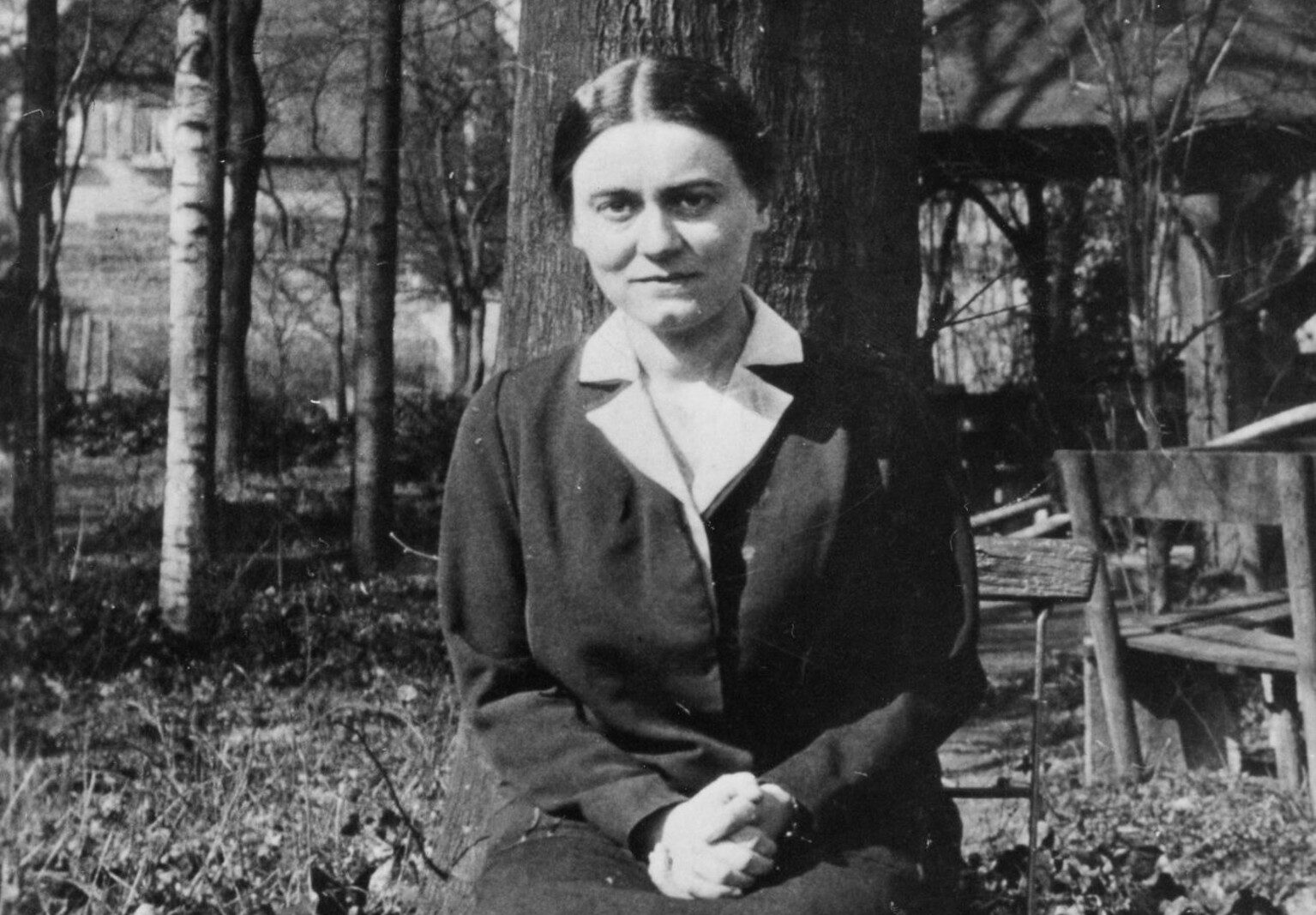
She was a Discalced Carmelite, now known as St. Teresia Benedicta a Cruce, canonized on account of the extraordinary witness of her faith. She was a Jewish convert to Catholicism, murdered alongside her people in Auschwitz. Today, she is deeply appreciated by many for the spiritual depth of her writings, inspired by St. Teresa of Avila and St. John of the Cross, who helped her understand her suffering alongside her people and find meaning in it.
But for me, she is firstly a philosopher. I was looking for a philosopher who is truly at home in modern philosophy and integrates it with the best aspects of the historical record, including the Franciscan contributions. In Stein’s writings, I found this—not the history of Franciscan philosophy, but modern philosophy fit for Franciscans.
Her first philosophical work, written at age 24, focused on empathy as the human ability to understand the inner world of another. Over the next five years, she studied the difference between psychology and the humanities.
She distinguished psyche from spirit. Psyche is what we share with some animals. It is what psychologists study by empirical observation of human behaviour. Spirit, however, is characteristically human. It manifests as being motivated by values in actions that we want to be meaningful. The humanities study this shared world of values and meaning-seeking humans.
But how do we form a shared world of values, akin to the shared world of scientific facts, such as insights from psychology? Stein’s exploration of this question gives her deep insights into how individuals become communities through mutual understanding. She explains that while the spirit differs from the psyche, it is built upon it. Our spirit is not contained in but enabled by the body. Embodiment is very important to Stein.
This is very interesting to a Franciscan, and we can use it to explore the meaning of one of our favourite stories: St. Francis calling other creatures his brothers and sisters. Our care for creatures and creation is meant to be analogous to God’s care for us. We express our gratitude for God’s care by caring for all else that God has created.
What makes Stein an excellent choice for Franciscans in need of a modern philosopher is that her philosophy is fundamentally centred on care. We are held in existence by God, and the knowledge that we exist should inspire confidence that our lives have meaning and significance, despite being fragile, embodied natural beings. Because we recognize our existence as meaningful simply because we are, we recognize that everything else God has created is also meaningful.
Stein belongs to the same group of early 20th-century German philosophers as Martin Heidegger, who became the most famous—or infamous, as many have remarked on account of his spinelessness when confronted with the evil of the Nazis. While Heidegger emphasizes existential anxiety, Stein emphasizes existential trust. For Heidegger, care means a highly technical and abstract concept that might just possibly be no more than self-care. For Stein, care means exactly what it is supposed to mean. This makes her an excellent choice for Franciscans looking for a philosophical guide suitable for our time.
(For much more on this topic, see “Being’s Challenge and Nature’s Care: Science, Edith Stein, and Franciscan Life” in the Writings section.)